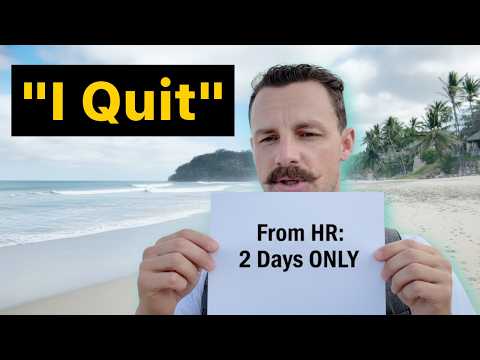


Imagine this: it’s Wednesday morning, and you’re on a beach in Mexico. You’re not on vacation. You’re not retired. And you definitely don’t have a trust fund. If someone told you ten years ago, while you were grinding away in corporate America, that you could be making $37,000 a month working only three days a week, you’d probably think they were lying. But here we are. This isn’t about some secret business idea or a new hustle. It’s about a fundamental shift in how we approach work and success.
You don’t have to trade your entire life for money. There’s a way to build a real business that pays you $10,000, $20,000, $30,000, or even $50,000 a month without being chained to a desk under fluorescent lights, reporting to a boss who couldn’t care less about you. It’s called a lifestyle business.
The Unsexy Truth About Freedom
Why don’t more people talk about lifestyle businesses? Because it’s not ‘sexy.’ You won’t see someone earning $500 million a year with this approach. There’s nothing flashy about saying, “Hey, build a small business that allows you to work three days a week and live your life however you want.” But the truth is, it’s a proven path to freedom, and I’m living proof.
This realization didn’t come from reading a book or watching a YouTube video. It punched me in the face, twice.
The First Punch: A Tragic Loss
A few years ago, I was in a typical 9-to-5 corporate role. On paper, everything looked great. I was earning a six-figure salary, had three weeks of vacation, bonuses, and health benefits. I was doing exactly what I was ‘supposed’ to do, climbing the corporate ladder, putting in extra hours for that next promotion. Then, three days before Christmas, my world shattered. My best friend was tragically killed in a car accident.
It shook me to my core. I remember sitting at my desk under those stuffy lights, wondering, “What am I doing here? What’s the meaning of all this work for 40-plus years of my life?” But I didn’t act on it. I pushed those feelings down and kept going.
The Second Punch: Corporate America’s Empathy Gap
Just a couple of months later, my mother, the most important person in my world, passed away. I walked into HR, uncomfortably emotional, to share the news. Their response? “You get two days bereavement leave.” Two days. That’s all corporate America offered me to grieve and process the loss of the woman who raised me, who gave me an amazing childhood, who was always my support person, and who I called when things were tough.
Sitting at that HR desk, something fundamentally broke inside me. It wasn’t a Hollywood movie moment, but a quiet, internal shift. I knew I needed to do anything I could to escape corporate America.
Beyond Rage Quitting: Asking Different Questions
I didn’t immediately rage quit out of spite. I didn’t find some magical YouTube video promising instant riches. Instead, I started asking different questions. Instead of “How can I get a promotion?” or “How can I find a better-paying job?” I began asking, “How can I build something that allows me to get my time back?”
This wasn’t about finding more time to hustle on a side gig after work. It was about gaining meaningful time, the kind that lets you live the ‘4-Hour Workweek‘ dream that Tim Ferriss wrote about. This question led me to a remarkably simple concept: a productized service.
The Power of a Productized Service
A productized service is a business model that allows you to package a skill and sell it repeatedly without you needing to be there every hour, picking up the phone, or putting out fires. It doesn’t require investors, a huge startup cost, a massive team, or 60-hour work weeks. It’s a clean business that funds your life, rather than draining it.
Fast forward to today. Last month, I made $37,000 working only three days. This wasn’t ‘time off’ where I was constantly on my phone. I was completely disconnected, spending time with my kids, not needing to hop on a laptop for a quick Zoom call. It was actual disconnection.
A few weeks ago, I took a Tuesday off for powder skiing in Canada. Now, I’m spending a couple of months in Mexico because the snow isn’t great. The best part? I didn’t have to ask a boss for permission to work remotely or take a vacation. More importantly, running a lifestyle business allows me to be more present with the people I care about, my children, and my incredible wife. I no longer feel trapped in a cubicle waiting for Friday at 5 PM, and I no longer dread Sunday nights.
I’m not sharing this to brag. I’m sharing it because if you’ve felt the way I felt in corporate America, I want you to know there’s another way.
Building Your Own Lifestyle Business: The 3-Step Formula
This isn’t magic; it’s a model you can follow. Here’s how to build a productized service:
Step 1: Pick One Skill
Don’t offer a whole menu of services. Pick one skill that you can package as a result someone will pay for. For me, it was search engine optimization (SEO). That was the value I could provide to law firms we took on as clients. For you, it might be bookkeeping, legal services, accounting, consulting, or photography. Your specific business idea is less important than picking one thing and going deep on it. If you’re stuck, consider something you already do at your corporate job. Search engine optimization is a great skill to productize.
Step 2: Package it as a Flat Monthly Fee or One-Time Fee
Never price your services hourly. That’s just another way to trade your time for money. Instead, set the price and the scope, and the client pays you every month or for that one-time service. For example, one of my clients was excellent at Ecovadis certification for large companies. When I started pricing my SEO services at $2,500 a month, you don’t need many clients to hit $37,000 a month. That’s enough to quit your job.
Step 3: Use AI to Build Automated Systems
This is the ‘buy back your time‘ principle, amplified. For every task in your business, assign it to one of three categories: automate it, delegate it, or delete it. It’s that simple. If you’re doing all the emailing, calls, delivery, and manual copying and pasting, even with AI for better emails, you’re just building another job, not a lifestyle business. Leveraging AI automation tools is key.
That’s the formula: one skill, one offer, and one automated process to deliver your product. It doesn’t need to be more complicated than that. Many online gurus try to overcomplicate things to sell expensive courses or coaching packages, but you don’t need any of that.
You do need to take action. Scrolling from one video to the next without implementation will leave you in the same place a year from now: lots of knowledge, but no action. This blueprint is free, and you can use it to do exactly what I did.
The Hard Part: Execution and Accountability
The blueprint is the easy part. The execution, accountability, and consistency, that’s the hard part, and it’s something nobody online wants to talk about. It’s figuring out where to find clients, how much to charge, and what to automate versus what to do manually. The biggest reason people fail is when it’s 11 PM, your kids are in bed, and you’re doom-scrolling, seeing a new business idea on YouTube or TikTok. You think, “Maybe I should do that instead.”
That’s when you need someone to say, “No, you don’t. Here’s what you need to keep doing.” And keep doing it. That’s why I built the Autogrowth Academy. It’s a community where I host weekly coaching calls and provide free courses to dive into how I use AI to build automated systems and market for clients.
Inside, you’ll get all my frameworks, like my client acquisition framework and Google Ads templates. More importantly, it’s a room full of people trying to build a business that funds their life instead of consuming it. If you’re not ready for it, that’s fine. Subscribe to my YouTube channel for more videos to stay motivated. But remember, action is what truly counts.